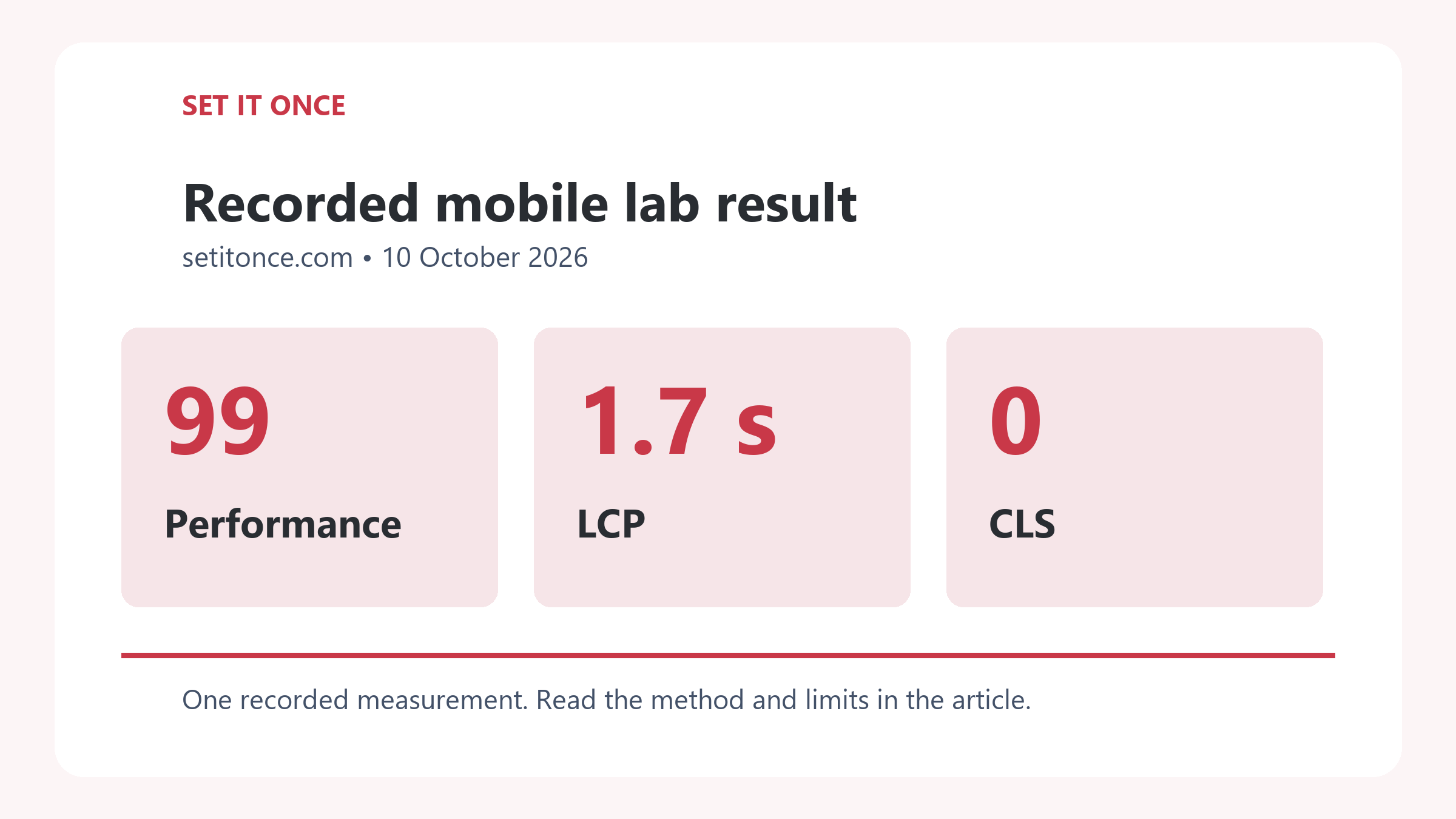
A speed service is easier to assess when you can inspect the work. This case documents the optimisation of our own WordPress website, Set It Once, on 10 October 2026. It is a first-hand project example, not a customer testimonial.
The recorded mobile homepage result was 99 for Performance, with a Largest Contentful Paint of 1.7 seconds and a Cumulative Layout Shift of 0. The public report is linked below. Those are laboratory measurements from one test, not a promise for every visitor.
The problem: a small site with avoidable loading work
The site combines English and Bulgarian marketing pages with WordPress and WooCommerce. A visitor reading about a service should not have to load store resources that the page does not use. Large font files and unnecessarily heavy portraits can also delay useful content.
The task was to reduce this loading work while preserving the visual identity, Cyrillic text, navigation and consent controls. Removing a dependency simply to improve a score would not count as success if a page or interaction stopped working.
What changed
- Fonts: the theme uses local WOFF2 files in place of its larger TTF files. The main font weights are preloaded. Store font subsets retain the Cyrillic characters needed by the Bulgarian interface.
- Portraits: images use optimised WebP versions with explicit dimensions. The originals remain available; the image treatment is not evidence of a different person or an additional credential.
- Page resources: unnecessary WooCommerce assets were removed from marketing and coming-soon pages. Dependencies needed by the relevant pages were retained.
- Delivery: theme CSS no longer requires a separate blocking stylesheet request. Suitable scripts are deferred with their dependencies preserved, and public static theme files have a 30-day cache lifetime.
- Basic usability and SEO: the work also addressed a main landmark, a password button’s size and missing meta descriptions.
These changes solve different problems. Image dimensions help avoid movement during loading. Smaller fonts reduce bytes. Removing unused assets reduces requests and work. None of them makes an unclear service page useful on its own.
The measurements you can inspect
The following results were recorded on 10 October 2026 in Google PageSpeed Insights. Open the report for the exact test conditions and diagnostics. The reports were captured before this case article and the subsequent author biography update were published.
| Page and report | Mobile Performance | Desktop Performance |
|---|---|---|
| English homepage | 99 | 100 |
| English services | 100 | 100 |
| Bulgarian author profile | 98 | 100 |
The homepage’s mobile report records First Contentful Paint at 1.4 seconds, Largest Contentful Paint at 1.7 seconds, Total Blocking Time at 0 milliseconds, Cumulative Layout Shift at 0 and Speed Index at 2.4 seconds. It uses an emulated Moto G Power, slow 4G and an initial page load. Accessibility, Best Practices and SEO each scored 100 in that report.
There is no comparable published baseline in this case. We therefore report the final recorded measurements without claiming a percentage improvement or a number of seconds saved.
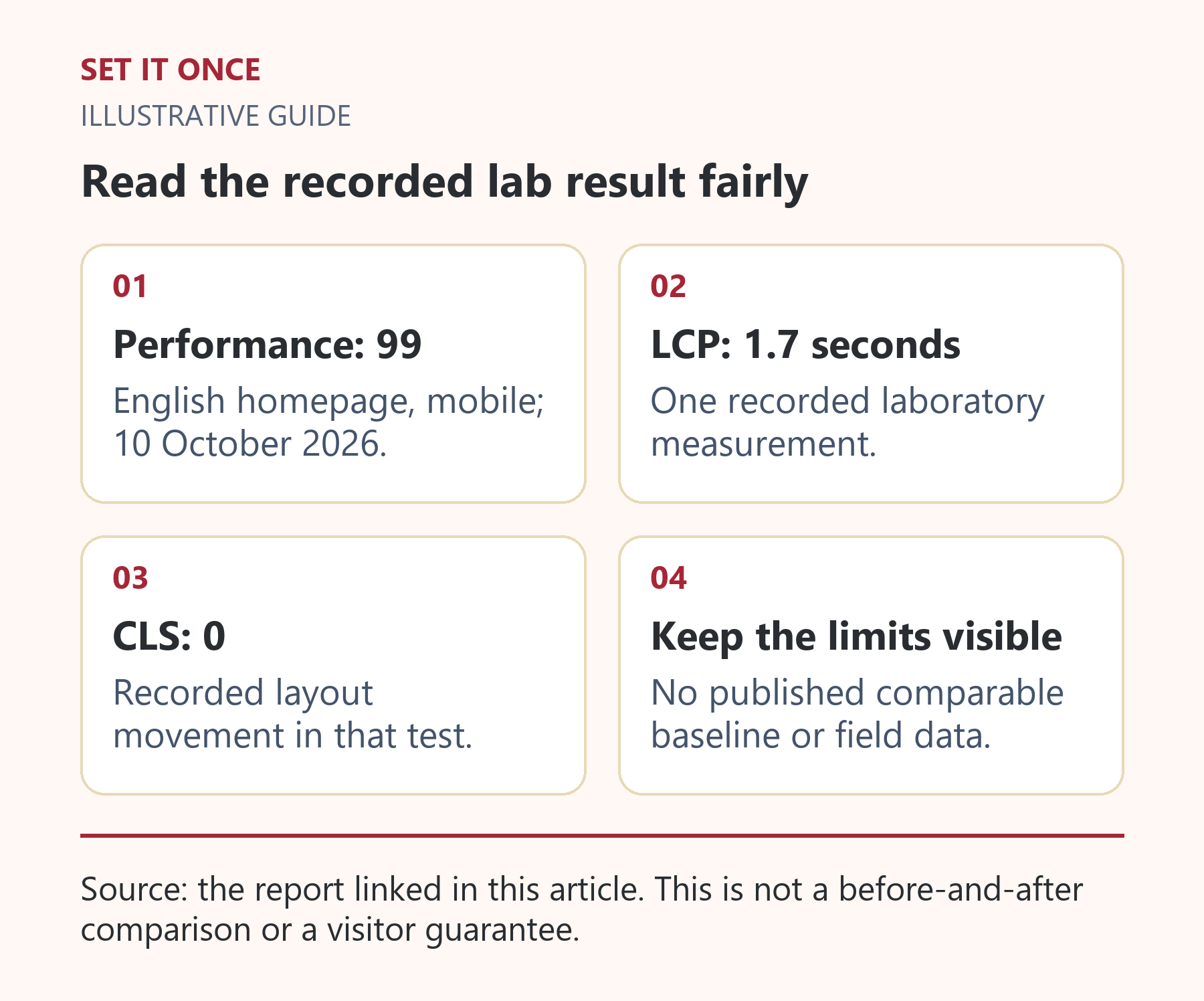
Original illustrative guide: Set It Once. Source: the report linked in this article. This is not a before-and-after comparison or a visitor guarantee.
Read the text version
- Performance: 99. English homepage, mobile; 10 October 2026.
- LCP: 1.7 seconds. One recorded laboratory measurement.
- CLS: 0. Recorded layout movement in that test.
- Keep the limits visible. No published comparable baseline or field data.
What the scores do not prove
The report has no Chrome User Experience Report data for the site. It cannot establish how all real visitors experience the pages. Different devices, networks, cache states and later content changes can produce different results. Google explains the distinction in its PageSpeed Insights documentation.
A Lighthouse SEO score of 100 covers a set of technical checks. It does not prove strong rankings, comprehensive SEO, accessibility for every user or a security certification. The homepage report still includes a long-task diagnostic. Some Bulgarian pages had forced-reflow notes during the wider check.
Account, cart and checkout pages retain intentional noindex settings. We did not make private or transactional pages indexable to improve their SEO score. The project also does not establish a sales increase or a guaranteed Core Web Vitals field result.
How to apply the approach to your site
- Measure a representative public page and save the report before editing.
- Separate image, font, script and server issues. Start with the largest avoidable cost.
- Preserve a recoverable previous version and change a limited set of resources.
- Check the actual page, navigation, consent controls and relevant interactions after the change.
- Rerun the same test and compare conditions as well as scores. Monitor real-user data when it becomes available.
If you want help with your own WordPress site, see our WordPress speed optimisation service for the scope, PageSpeed targets and payment terms. Include the URL and the pages or actions that feel slow so we can assess the right starting point.
Quick answers
Frequently asked questions
Are these results from a real project?
Yes. The case documents Set It Once's own WordPress website, with public Google PageSpeed Insights reports recorded on 10 October 2026. It is not a customer testimonial.
Does a PageSpeed score of 99 guarantee fast loading for everyone?
No. It is a laboratory result under specific device and network conditions. The report has no real-user CrUX data, and later tests can differ.
Which changes were made to the website?
The work used local WOFF2 fonts, optimised WebP portraits, removed unused store assets from marketing pages, adjusted CSS and script loading and addressed basic usability and SEO issues.
Does a Lighthouse SEO score of 100 guarantee rankings?
No. Lighthouse checks selected technical requirements. Search rankings, useful content, real-user experience and business outcomes need separate evidence.

About the author
Martin Iliev
Martin builds Set It Once to help people spend less time on repeated work. His guides explain what you can try, how to check the result and where the limits are.
More about Martin