
An accurate translation can still lead visitors to the wrong language, an outdated offer or a missing next step. Treat Bulgarian and English versions as one maintained pair with separate public URLs. Review the relationship as well as the words.
Match the purpose and conditions
Compare the reader’s question, service scope, price conditions and next step on both pages. Localisation should make the content natural in each language while preserving the actual offer. Do not translate an unsupported promise more elegantly and leave it in place.
Keep a pair register with EN URL, BG URL, content owner and last substantive review. A translated title alone does not establish that the body, form and linked destination are current.

Test the language switch in context
| Visitor action | Expected destination |
|---|---|
| EN to BG on an article | The corresponding Bulgarian article. |
| BG service CTA | The relevant Bulgarian service or explained fallback. |
| Return to the index | An index in the selected language. |
| Open a related guide | A relevant guide with an honest language label. |
A language button that always opens the homepage makes the visitor search again. If the equivalent page does not exist, show a clear fallback rather than imply that it does.
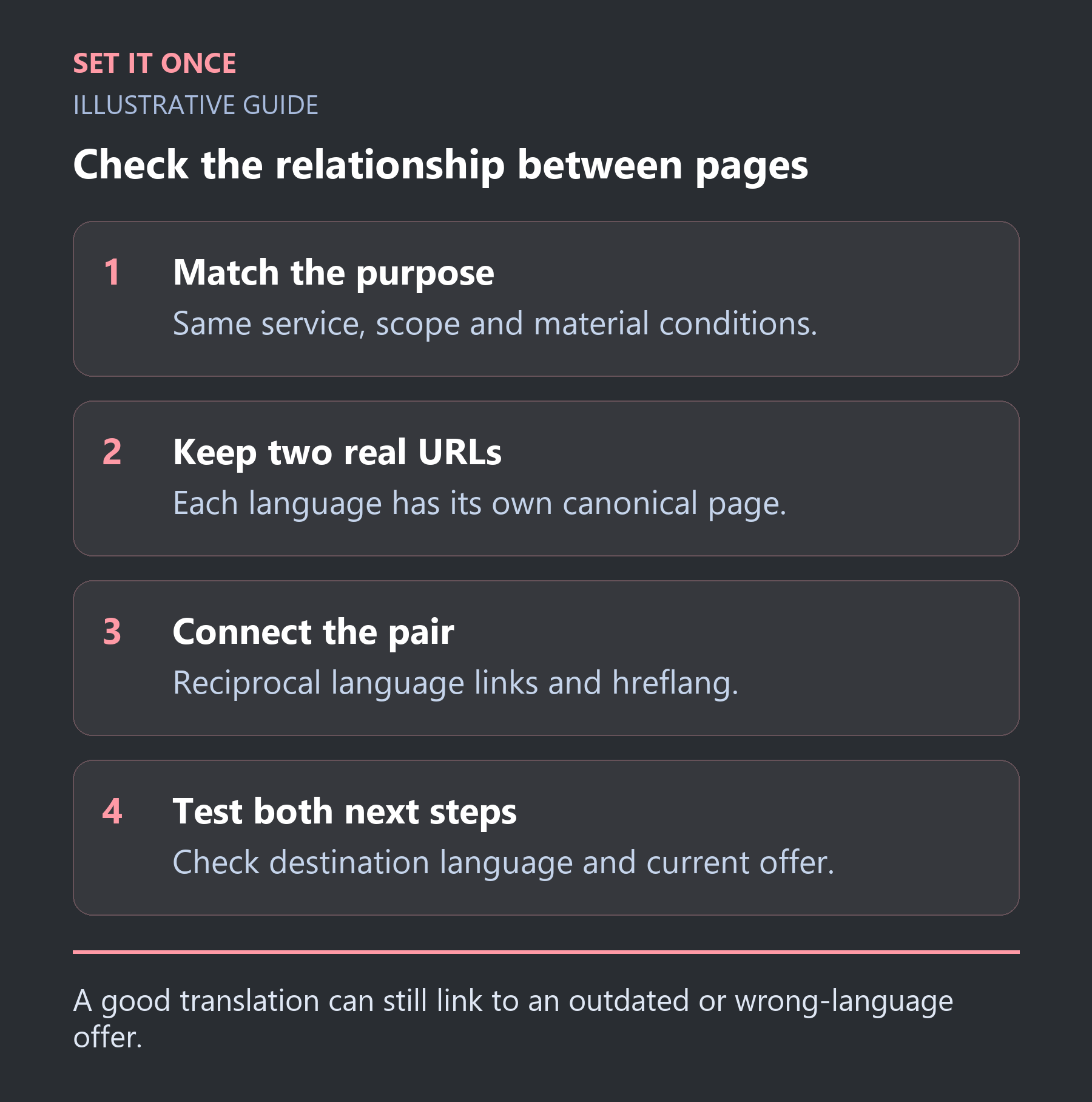
Original illustrative guide: Set It Once. A good translation can still link to an outdated or wrong-language offer.
Read the text version
- Match the purpose. Same service, scope and material conditions.
- Keep two real URLs. Each language has its own canonical page.
- Connect the pair. Reciprocal language links and hreflang.
- Test both next steps. Check destination language and current offer.
Check the search-facing relationship
Google’s localized-page guidance describes reciprocal hreflang annotations between language versions. Check the actual rendered output for both pages, their language declarations and canonical URLs. Each indexable language page should represent its own content; do not automatically canonicalise every translation to English.
Do not point visitors or annotations to an unpublished equivalent as though it were public. For a scheduled pair, verify the relationship after both URLs become available. Hreflang describes language alternatives; it does not guarantee indexing or a particular ranking.
Review the complete experience
- Open both pages without an administrator session.
- Check headings, SEO descriptions and social previews separately.
- Inspect images and contextual alt text.
- Follow the language switch and the main CTA.
- Test the longer Bulgarian text at a narrow width.
Hypothetical example: both articles are correct, but the Bulgarian CTA reaches an English form without warning. Repair the destination or label the fallback. The remaining mismatch is part of the page pair even though the translation itself is good.
When changing an offer, assign a review of the other language in the same task. Record whether both are updated or one still needs work. This simple ownership rule helps prevent gradually diverging versions.
Maintain a pair record that survives the next edit
A useful bilingual pair record includes both canonical URLs, native page IDs, language, content owner, source offer version, main CTA destination and last substantive review. Record whether the translation is equivalent, adapted or awaiting an update. Two checked boxes labelled EN and BG do not reveal a mismatched price or a missing destination.
For a hypothetical service update, the English page changes its scope and required access. The task should identify the corresponding Bulgarian page and the same changed conditions. Translate the meaning naturally, then compare the substantive details side by side. Bulgarian can be longer without needing a smaller font or omitting the qualification.
Use a mismatch checklist beyond the article body
Inspect the heading, description, social preview, image text, alt text, related links, form labels and confirmation. Follow the CTA and return to the index. A translated article connected to an unexplained English form still has an incomplete journey, even when its paragraphs are accurate.
If no equivalent destination exists, decide whether to create it, provide a clearly labelled fallback or remove the misleading switch. Do not map every missing translation to the homepage while presenting that as the same page in another language.
Check canonical and language alternatives for different purposes
Canonical identifies the preferred URL for the content. Hreflang identifies language alternatives. For genuine separately indexable translations, verify the intended self-canonical and reciprocal alternatives in the rendered output. Include each language page itself in its set, following Google’s documentation. These annotations do not translate text or repair a broken language button.
For a scheduled pair, retain the native relationship and verify public alternatives once both pages are available. Do not expose a preview or unpublished URL as a working public alternative. When a slug changes, review redirects, internal links and annotations together. Finish with a real click from each article to its counterpart and a check of the next action in that language.
Take one practical next step
If your language navigation or page pairing needs a technical correction, describe it through custom development. Scope, timing and price are agreed before work starts. An enquiry does not place an order or guarantee a result.
Sources and further reading
Quick answers
Frequently asked questions
Must the two articles have identical wording?
No. Natural localisation may differ. The scope, factual conditions and intended next step should remain consistent.
Does hreflang guarantee indexing?
No. It signals language alternatives. Crawlability, content quality and indexing are separate matters.
What if the translated page is still scheduled?
Do not present it as a live equivalent. Verify and expose the relationship when both public versions are available.

About the author
Martin Iliev
Martin builds Set It Once to help people spend less time on repeated work. His guides explain what you can try, how to check the result and where the limits are.
More about Martin