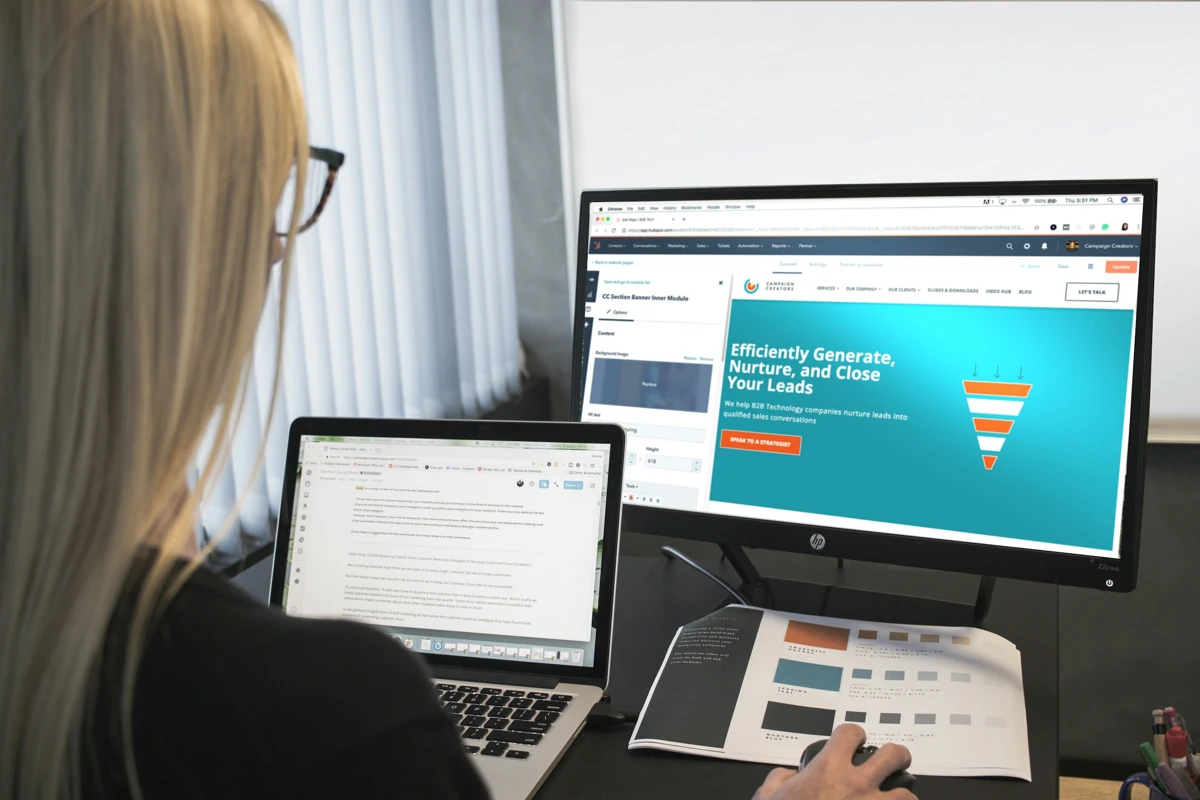
A buyer wants to know whether you solve their problem, what is included and what happens next. A page that answers those questions gives search systems clearer information too. Begin with the buying decision and the evidence you can actually show.
Map buyer questions to visible evidence
| Buyer question | Useful page evidence |
|---|---|
| Is this for my situation? | Specific task, supported systems and prerequisites |
| What will I receive? | Deliverables and acceptance conditions |
| What does it cost? | Real price or how a quote is agreed; payment conditions |
| Can I trust the claim? | Named author, dated demonstration and clear measurement limits |
| What happens next? | Working contact route and what information to provide |
This evidence map is a planning aid. It does not establish a ranking factor or require you to expose private customer information. A demonstration on your own site can be useful when clearly labelled and documented.

Publish claims you can defend
Replace “the best AI automation” with the actual work: which task, which supported tools, what access is needed and how completion is checked. If a product is in early access, say so near the offer. Distinguish a proposed workflow from a deployed integration.
A before-and-after example should state the date, scope and conditions. Do not imply a permanent outcome from one test. Clearly label illustrative numbers. This makes the page more useful even to a buyer arriving through a direct link.
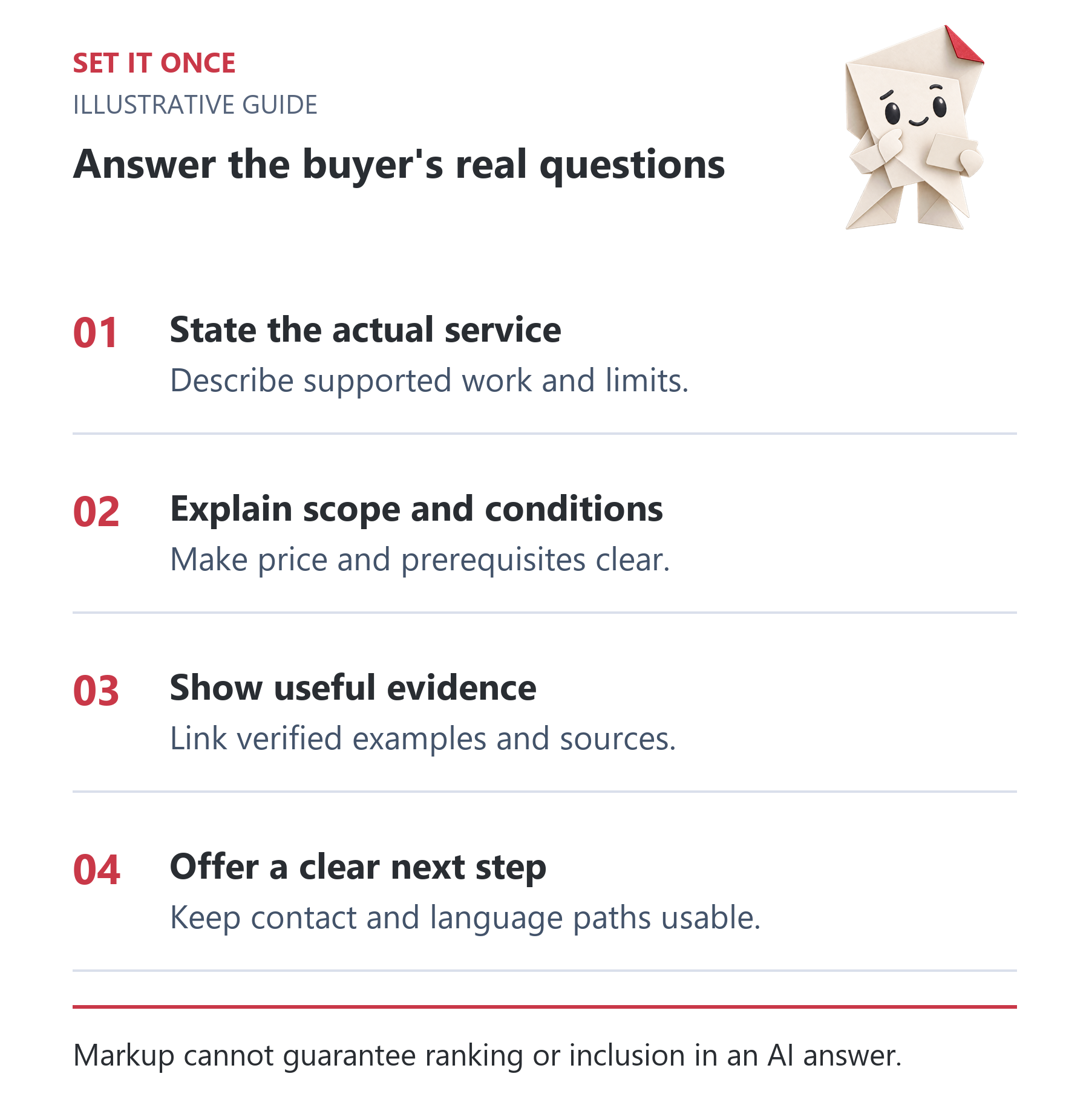
Original illustrative guide: Set It Once. Markup cannot guarantee ranking or inclusion in an AI answer.
Read the text version
- State the actual service. Describe supported work and limits.
- Explain scope and conditions. Make price and prerequisites clear.
- Show useful evidence. Link verified examples and sources.
- Offer a clear next step. Keep contact and language paths usable.
Use connected schema that matches the page
For an article, BlogPosting and BreadcrumbList can describe the content and its navigation. A service page can describe a Service and its provider. Person and Organization identify real authorship and the business. Offers need actual matching terms; reviews need genuine evidence. Avoid adding unrelated types just because a plugin permits them.
Google says AI Overviews and AI Mode use the normal SEO foundations, without special AI markup requirements. Structured data should match visible content. Eligibility does not guarantee crawling, indexing or inclusion.
Check accessibility and the actual next step
Confirm a public successful response, intended indexing, a self-canonical and reciprocal language references where true translations exist. Inspect robots and CDN rules separately from the page HTML. Keep important answers in readable text and link from relevant public pages.
Then use the CTA on a mobile device. Can the visitor read conditions and submit an enquiry? Search visibility has limited value if the next step fails.
Claim: __. Supporting evidence: __. Date and scope: __. Visible limitation: __. Buyer action: __. Owner for updates: __.
Use Search Console to monitor actual search discovery when available. Record referral evidence for other channels; do not infer AI recommendations from a valid schema report.
Rewrite the offer around a buying decision
“We deliver innovative solutions that transform your business” could describe almost any supplier. It leaves the buyer to infer the actual work. A more useful hypothetical statement is: “We connect the enquiry form to your existing task board, preserve the original record and agree who handles failed deliveries.” This identifies a problem, a deliverable and an operational boundary.
Follow it with who the service suits, the prerequisites, included work, exclusions and the first decision the buyer must make. For example, a site owner might need access to form settings and the destination workspace before implementation can be assessed. State that requirement before the enquiry, rather than surprising the customer after they request a quote.
Build an evidence ladder instead of manufacturing authority
Start with what can be inspected: a sample deliverable, an explanation of the method, a permission checklist or a documented project. Label a hypothetical workflow as a proposal. Label your own website as your own project. A measured client outcome needs its actual context and permission; a stock photograph cannot establish that evidence.
Place important qualifications next to the claim they limit. If a speed result concerns one mobile lab test, say so beside the number. If a product is early access, make that visible near the next action. Do not rely on a distant FAQ to correct an overconfident headline.
Make the page independently understandable
Use descriptive headings and sentences that name the service and its conditions clearly. A visitor arriving directly from search should not need the homepage to understand what is offered. Keep essential information in readable page text rather than only in an image, animation or unexplained acronym.
Google states that its AI search features use established SEO practices and that content should help people accomplish their goal. That supports clear, accessible information; it does not establish a special writing formula that guarantees citations. Structured data should describe the same visible offer.
Review with five buyer questions
Can a prospective customer explain what they will receive, whether they qualify, what is excluded, how pricing is determined and what happens after enquiry? Ask someone unfamiliar with the service to answer those questions using only the page. Rewrite the places where they must guess. Measure real enquiries and their suitability over time, not only page views or a plugin’s content score.
Take one practical next step
If this is a problem in your team, explore AI consultation. Describe one task, the software you use and the result you need. Scope and terms are agreed before work begins.
Sources and further reading
Google: AI features and your website.
Quick answers
Frequently asked questions
Do I need special schema for Google AI answers?
Google does not require special AI markup for AI Overviews or AI Mode. Follow normal SEO foundations and publish useful, accessible content.
Should I add every schema type?
No. Use types that describe the visible page and eligible real information. Extra irrelevant markup does not create credibility.
Does valid schema prove my page appears in AI answers?
No. It verifies markup, not inclusion. Look for actual search and referral evidence.

About the author
Martin Iliev
Martin builds Set It Once to help people spend less time on repeated work. His guides explain what you can try, how to check the result and where the limits are.
More about Martin