
AI slop is low-quality content made with artificial intelligence, often in large quantities and with little care for the person consuming it. It can be an article, image, video, comment or entire website. The output looks finished, but when you need an exact answer, supporting evidence or a usable next step, there is little underneath.
Is it worth making? Sometimes the producer has a short-term economic incentive: low production costs, many attempts and a chance of attracting attention. The reader often receives less value. For a business that sells through trust, mistakes and lost credibility can cost more than the writing saves. A sensible decision starts by separating a disposable draft, entertainment and public information that someone will rely on.
What AI slop means, and what the label misses
Cambridge Dictionary describes AI slop as low-quality digital content created by AI. It is a disapproving label, not a technical standard with a definitive test. For this guide, a useful practical question is whether the material delivers the value it promises.
The grammar may be excellent, the design attractive and the citations convincing at first glance. None of those establishes usefulness. An article about “better customer service” that repeats “listen to customers” across ten sections does not tell an owner who handles a missed enquiry or when. It may be factually unobjectionable and still contribute almost nothing.
The reverse matters too. A generated diagram that explains a difficult process, or an AI draft developed with real evidence and a checked example, does not become slop because of the tool involved. Humans can produce shallow content as well. Generative tools make it easier to produce and distribute that content at greater volume.
Why people produce so much of it
The proposition looks attractive: if each piece costs very little, publish many pieces and hope a few capture attention. Headlines, visual surprises and emotional stories are easy to generate in variations. A similar structure can be adapted rapidly for different subjects and languages.
However, production and verification have different economics. Generating a convincing claim takes seconds. Establishing whether it is true can require a primary source, a practical test or specialist knowledge. When a team measures only publishing volume, it can optimize output while transferring the verification burden to its audience.
That explains the incentive. It does not prove that every high-volume publisher is profitable. Without costs, revenue, a reporting period and traffic sources, a screenshot showing a large view count is not evidence of a sustainable business.
How to recognize it without guessing who wrote it
Judge the content by what it enables you to do. Smooth prose, a particular word or a punctuation habit does not establish AI authorship. The following signs are reasons to examine quality:
- An unfulfilled promise: the headline offers a method, but the article supplies general advice without inputs or a sequence.
- Precision without provenance: percentages, quotations or “studies” appear without a source you can inspect, a time period or context.
- Invented specificity: an allegedly real case has no method or evidence, or an illustration is presented as a photograph of an actual event.
- Repetition disguised as depth: sections restate one idea instead of answering distinct questions.
- No boundaries: the recommendation supposedly works for everyone, without costs, prerequisites or unsuitable cases.
- No checkable outcome: you cannot tell whether following the advice produced the intended result.
For video, check where the claim originated, who published it and whether independent evidence supports it. Visual defects may offer clues, but a convincing image does not prove an event occurred. In business imagery, pay particular attention to the implied claim: a fictional office scene should not act as evidence of a real team.
Is there any value? When fast AI output makes sense
Fast AI output can help with
- Internal drafts and prototypes
- Clearly identified entertainment
- Limited experiments using real facts
Quality matters most for
- Instructions with real consequences
- Service and performance promises
- Content that needs to earn trust
For prototypes and internal preparation, cheap, imperfect output can be sufficient. Ten headline options, temporary layout copy or synthetic data for an isolated test may save time. Label it, keep real personal data out of test material and prevent provisional copy from accidentally becoming a public promise.
For clearly identified entertainment, an invented world may be the point. An absurd AI video does not need to be a documentary when the audience understands the format. If people enjoy it, it provides entertainment value. Calling that slop may partly reflect taste. An invented rescue story presented as a real event creates a different expectation.
For limited experiments, you can try different ways of explaining a genuine service. Keep the facts consistent and measure a relevant action, such as a qualified enquiry. Do not manufacture testimonials or results to make a variation more persuasive.
The common condition is that rough output is acceptable when the consequences are limited, the material is clearly identified and expectations are appropriate. Once you add substantive usefulness and verification, you are moving away from what people normally mean by AI slop.
When it is not worth it, and why
A service page needs to give a potential customer reasons to trust you. Generic copy that could describe any competitor does not explain your actual scope, process or limitations. If AI adds an unsupported capability or invented delivery date, the content can create expectations your business cannot meet.
With instructions, one mistake can cost more than the article itself. An incorrect setting could destroy data, a misleading financial example could distort a decision, and an invented health recommendation could cause harm. NIST describes confabulation as confidently presented false or erroneous output, including fabricated reasoning and citations. Confidence in the wording does not replace evidence.
There is also an attention cost. If every internal answer becomes long and unchecked, colleagues spend time interpreting and repairing it. An automation might save its author five minutes while costing three recipients ten minutes each. Measure the whole process rather than generation speed alone.
A worked cost example: 100 cheap articles can become expensive
This is a hypothetical monthly comparison, not a customer case. We compare 100 mass-produced drafts with eight developed pieces. Time is valued internally at €20 per hour. The tool allocation is an illustrative assumption, not a market quote.
Hypothetical example: €20 per hour. Bar lengths compare total costs, not quality or future sales.
View the cost breakdown
| Cost | 100 mass-produced pieces | 8 developed pieces |
|---|---|---|
| Tools | €30 | €30 |
| Preparation and generation | 5 hours = €100 | 4 hours = €80 |
| Verification and editing | 20 hours = €400 | 12 hours = €240 |
| Publishing, corrections and maintenance | 10 hours = €200 | 4 hours = €80 |
| Total | €730 | €430 |
The high-volume option is cheaper per page: €7.30 versus €53.75. Its total cost is higher. At an incremental contribution margin of €100 for each genuinely additional customer, after direct delivery costs, the first option needs at least eight such customers to cover €730. The second needs five to cover €430.
This does not prove the eight articles will generate more customers. It identifies what needs measuring. Use: net contribution = additional customers × contribution margin per customer - full content cost. Include distribution, other relevant costs and the actual time to a sale. Do not automatically attribute customers who would have purchased anyway to the blog.
Adapt the inputs using your own hourly value and margin. If you cannot check 100 articles, skipping editing lowers recorded costs while leaving mistakes for the audience to discover. It does not make the two outputs equivalent. A fair experiment needs a defined budget, comparable objectives and an observation period suited to the channel.
What this means for SEO
Google’s guidance on generative AI content does not establish a blanket prohibition on AI use. Its scaled content abuse policy covers producing many pages primarily to manipulate search rankings without adding user value, regardless of how the content is made.
The useful question is therefore not “How many articles can we generate?” but “Which specific task does this page help someone complete?” Replacing a city name across a hundred similar pages does not automatically create a hundred useful local resources. Real differences might include available services, conditions and local context. Length, FAQs and polished formatting do not compensate for a missing answer.
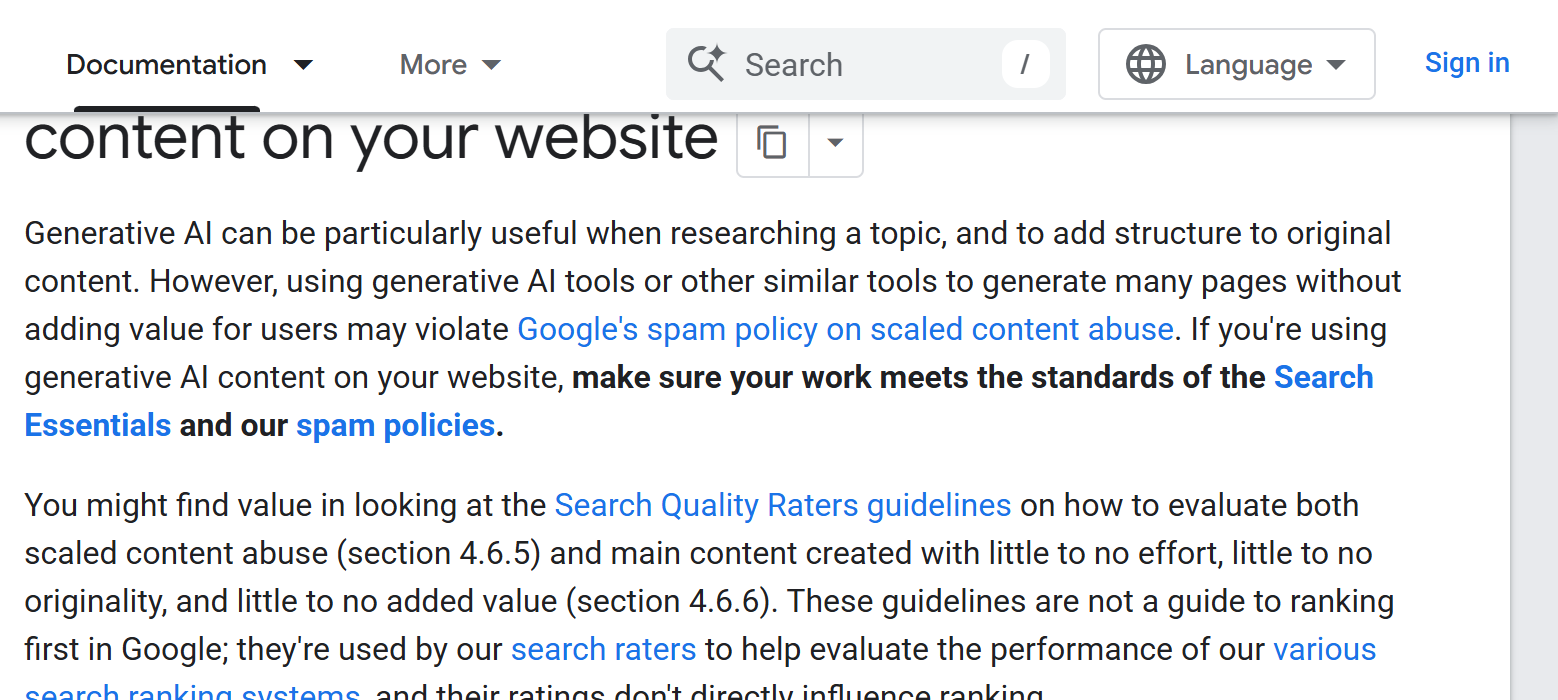
Read the text equivalent
The excerpt distinguishes useful AI assistance from mass generation without added value. It documents the source’s guidance rather than demonstrating a ranking outcome for any website.
From generic copy to something a reader can use
Generic advice
Consider a fictional WordPress maintenance business. A weak AI paragraph says: “Regular maintenance is essential for success. Update your plugins and create backups to improve security.” It is not necessarily false, but it does not help the reader perform the work.
No recovery plan, no test and no way to recognise a failed update.
A more useful starting point
A more useful version sets boundaries: “Before updating, back up both files and the database and establish how you would restore them. Use a staging copy when available. After the change, check login, key pages and the affected form with safe test data. If something breaks, record the error and reverse the specific change using the prepared recovery plan.”
A recovery plan, a safe test and a response to failure give the reader actions they can check.
To become a complete procedure, that explanation still needs exact steps for the relevant hosting environment, checked screenshots and a way to recognize successful recovery. The writer must not claim to have tested it when they have not. The improvement comes from practical assistance and verifiability rather than replacing common words with more “human” synonyms.
A practical workflow for useful AI-assisted content
- Define the reader’s decision. For example: “Decide whether to update independently or ask for help.” “WordPress matters” is too broad to guide an article.
- Collect evidence before drafting. Gather real conditions, documentation, permitted images and primary sources. Record what remains unknown.
- Give AI a bounded task. Request a structure, comparison or edit based on those facts. Explicitly exclude invented cases and numbers.
- Add an original contribution. Develop a worked example, a meaningful comparison, a checked procedure or a reusable worksheet. Paraphrasing alone may add little.
- Check claims separately from style. Open the sources. Confirm that each supports the precise statement, including its date, scope and limitations.
- Check the published result. Read it on a phone, follow its links and safely verify the steps you can test. Track enquiries and corrections.
A better brief improves the input; it does not guarantee a correct output. The publisher remains responsible for publication. For English and Bulgarian versions, separately check natural language, terminology and whether the example still applies. Translating weak content does not create value.
For a small team, assign one owner to each material claim and one final publication decision. This can be the same person. The practical benefit is that “someone probably checked it” becomes an explicit task with an identifiable result.
How to repair AI slop already on your website
Start with five to ten pages that matter commercially or already receive visitors. Record the user task, unique contribution, unsupported statements and next action for each. If the title promises a guide, the body needs an executable sequence and a recognizable success condition.
Improve pages with a clear purpose. Consolidate articles that answer the same question without a meaningful difference. Examine visits and inbound links before removing URLs; a genuine replacement may warrant a redirect. Correct misleading factual statements visibly. Do not delete an entire archive simply because AI was involved.
After the changes, monitor relevant signals: fewer repeated support questions, qualified enquiries, completed tasks and maintenance time. Likes and impressions describe attention. They do not provide a complete account of usefulness or profit.
If no one on the team can verify a specialist recommendation, narrow the article to facts you can establish or obtain appropriate expertise. Publishing less is preferable to presenting unsupported instructions with confidence.
What should your business choose?
If you need a temporary prototype or clearly identified entertainment, fast generation may be reasonable. If you need trust, a credible service page or consequential instructions, budget for evidence, editing and maintenance. A smaller set of materials with clear purposes can be a more manageable starting point than a large archive you cannot check.
Before the next publication, ask: “What will the reader learn?”, “How can they apply it?” and “How can they check that it is true?” If those answers are missing, publishing more material will not fix the underlying problem.
If you need help with topics and publishing, review Set It Once’s blog content service and compare its scope with your needs. Offering a service does not remove the requirement for each article to be useful; the service page states the current conditions.
Sources
Quick answers
Frequently asked questions
Is every AI-written article AI slop?
No. The term describes a low-quality result rather than every use of AI. Verifiable facts, a worked example, an actionable method and responsibility for publication are more useful criteria than the production tool alone.
Can AI slop make money?
It may attract traffic and revenue at a low production cost. Profit also depends on distribution, editing, conversions, maintenance and platform conditions. A large publishing volume or view count does not establish profitability.
Does Google automatically penalize AI content?
Google's guidance does not describe a blanket ban on AI content. Generating many pages primarily to manipulate rankings without adding user value can violate its scaled content abuse policy.
What should I do with weak AI articles already on my site?
Start with a small review. Improve pages with a clear user purpose, consolidate overlapping articles and correct unsupported claims. Redirecting, noindexing or removing a page depends on its purpose, existing traffic and inbound links.

About the author
Martin Iliev
Martin builds Set It Once to help people spend less time on repeated work. His guides explain what you can try, how to check the result and where the limits are.
More about Martin